
A Comprehensive Guide to Sourcing From China

Sourcing products in China offers numerous benefits, but it can be time-consuming to find the right suppliers, negotiate, and secure favorable deals.
Suppliers frequently encounter challenges when searching for a supplier or when entering into a business relationship, such as receiving products that do not meet the specifications and are of subpar quality.
To understand the Chinese market and effectively manage suppliers, extensive experience is essential. Therefore, seeking all available assistance is crucial.
This article outlines best practices, tips, and essential information to help you effectively source products in China.
What does “China Sourcing” Refer to?
Finding a supplier to deliver the best quality goods or services for your business is known as sourcing.
Similarly, Chinese sourcing involves finding high-quality goods and services with the assistance of local suppliers in China.
Depending on the scale of your business, importing goods from China may necessitate engaging multiple suppliers with diverse experiences in your industry.
For example, small business owners may benefit from establishing relationships with Chinese suppliers, while large enterprises may find value in partnering with a sourcing company based in China.
Why is it Beneficial to Source Products in China?
China is a major global trading partner with extensive supply chains capable of servicing businesses of all scales. Its capacity to produce, maintain, and distribute products on a large scale makes it an attractive sourcing option.
Additionally, there are several other compelling reasons to consider sourcing products in China. Here are other reasons why you should consider sourcing in China:
Various Suppliers Options. When it comes to sourcing suppliers in China, there is a wide array of options available. It is crucial to carefully consider the size of your business and strategically select suppliers that are in line with your budgetary requirements.
High-Quality Products at Competitive Prices. You can choose from a variety of suppliers in the market and seek out those that provide high-quality products at affordable prices.
Low Labor Costs. If you are looking for skilled laborers at affordable rates, then China should be one of your top considerations. Being a densely populated country, the cost of labor plays a significant role in determining the price of goods and services.
Affordable Quality Inspection. When sourcing from China, it’s natural to worry if the quality will match your expectations. Nobody wants the hassle of international exchanges or returns. That’s where product inspection comes in, but it can be expensive if you hire the service in your home country. In this case, choosing a one-stop service procurement agency in China will be your best bet for both peace of mind and cost-effectiveness.
Low Warehousing Costs. When managing multiple suppliers from China, it’s common to encounter varying lead times, leaving you with nowhere to store your goods until they’re all ready for shipment. Plus, when it’s time to gather your goods, consolidating them at one supplier’s location risks compromising your sourcing privacy. That’s where storage in China comes in as the ideal solution. As a one-stop sourcing agent, we offer comprehensive one-stop services, including storage facilities, ensuring convenience and safeguarding your sourcing confidentiality.
Sourcing Products from China Step-by-step Guide.
If you’re considering sourcing products from China, you might find the process daunting. It can be time-consuming and complex, but there’s a simpler way forward.
Here’s a step-by-step guide to sourcing in China that will help you navigate through the complexities and streamline your experience.
1. Take Plenty of Time to Find a Reliable Supplier
If you’re new to sourcing from China, your initial instinct might be to start with a quick Google search. Websites like Alibaba are popular choices for connecting with suppliers.
However, distinguishing between resellers and manufacturers online isn’t always straightforward, so it’s crucial to choose carefully.
Platforms like Alibaba offer features to help narrow down your search by rating suppliers and manufacturers across China.
But keep in mind, these ratings may not always be reliable since any supplier that pays for the Alibaba premium membership can receive a gold supplier rating.
So, take your time with your search and conduct thorough checks to ensure you find the perfect supplier for your needs.
Sourcing Tips: Before deciding between a manufacturer or supplier, it’s crucial to consider the size of your business, particularly in terms of your annual order volume.
China’s factory scale is often larger than anticipated, and direct factories typically have higher Minimum Order Quantities (MOQs). Generally, the lower the value of goods, the larger the MOQ required.
2. Hire a China Sourcing Agent
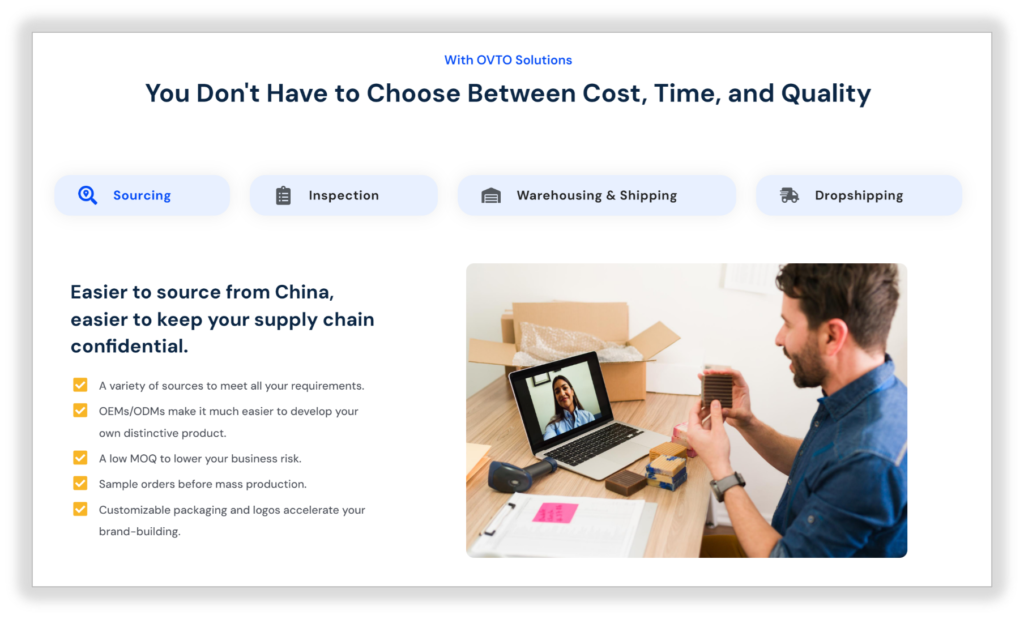
If it’s your first-time sourcing in China and you’re open to investing some resources, enlisting the help of a sourcing agent can be a convenient choice. This is particularly beneficial if you’re seeking products with specific technical specifications or custom designs.
Moreover, it’s a convenient option if you prefer to stay where you are and avoid traveling several times to China for factory visits and quality inspections.
Your sourcing agent will take care of all of that.
Another key advantage is the expertise of an experienced agent who is fluent in the local language. They play a crucial role in negotiating with suppliers on your behalf, ensuring favorable terms and smooth communication throughout the sourcing process.
At OVTO Sourcing, we’ve built a stellar reputation for efficiently sourcing products for businesses, saving valuable time and resources while ensuring a seamless process from start to finish.
Most importantly, by entrusting your sourcing to a reputable agent, you significantly reduce the risk of falling victim to scams or fraudulent activities. Local sourcing agents excel at vetting suppliers and manufacturers, providing an added layer of security and peace of mind.
3. Verify Suppliers to Ensure Quality and Reliability
After compiling a list of suppliers based on their experience, it is imperative to thoroughly verify the accuracy and validity of this information.
Here are a few things to check: Find out if the suppliers are a factory or just a middleman, and see if they have the necessary technical expertise and capability to produce what you are looking for.
You can check this information by looking at the suppliers’ VAT invoices, audited accounts, or the factory’s registration records. If your supplier can’t provide a business license or a company registration number, it’s best to avoid doing business with them.
You can verify all registration numbers with the local administrative government or the local Bureau of Industry and Commerce.
Last but not least, it’s advisable to request references from your supplier’s previous clients to confirm their track record and reliability. However, it’s understandable if they are unable to disclose their previous clients for privacy reasons, as long as all other factors demonstrate that your suppliers are reputable and certified.
4. Balancing Price and Quality for Maximum Value
One of the biggest benefits of sourcing in China is the significant cost reduction due to lower manufacturing and labor expenses.
When negotiating the price with your suppliers, keep in mind that all suppliers have a minimum cost for manufacturing the product.
It’s important to do some research on the costs of the product and the market price to have a good idea of what a reasonable price should be. With this information, you can tell that if you’re offered a price below the market price, the product’s quality might not be the best.
If the price goes below the minimum market price or the product’s cost, it should raise a red flag, as the supplier may be compensating for something that you might not have realized yet.
To protect yourself from potential issues, it’s best to avoid working with suppliers that offer you a price that is way too low.
5. Purchasing Directly from the Suppliers
Purchasing directly from the supplier instead of involving a middleman provides you with greater control over the entire manufacturing process. By doing so, you can avoid additional fees or commissions paid to intermediaries.
If you have the time and expertise to conduct your own supplier search, effectively communicate with them, oversee the manufacturing process, and manage warehousing and shipping from multiple sources, this approach could potentially reduce your costs to a certain extent.
When opting to buy directly from suppliers, it’s important to ensure that they can handle foreign exchange transactions. This is crucial because many reputable Chinese factories may not yet engage in foreign trade.
Despite locating a strong factory on a Chinese map, such as Baidu Maps, it may not be listed on any e-platform. Consequently, you may be unable to directly transfer funds to China and might need to engage an agent to facilitate the transaction.
Everything has two sides. The company you select on Alibaba is undoubtedly qualified for foreign trade. However, if you collaborate with a procurement agency, you will have access to a wider range of factory resources. China’s factory resources extend beyond what is showcased on Alibaba.
6. Establish Effective Communication with Your Suppliers
One of the primary challenges businesses encounter when sourcing from China is the difficulty in establishing clear communication due to language barriers and cultural disparities.
Many issues with supplier stem from misunderstandings and miscommunication.
Considering the potential for significant delays in delivery and production times, which can adversely impact your business and its profit margins, it may be worthwhile to consider hiring a translator.
Furthermore, all technical details, including product specifications, technical requirements, and packaging guidelines, should be documented in both languages rather than relying on oral arrangements.
It is essential to regularly discuss the progress of the work to promptly address any issues and ensure a smooth flow of communication. While a translator can assist with language barriers, they may not handle foreign trade matters, so it’s crucial to remain vigilant and attentive to all aspects of the process.
If your time is more valuable than investing in extensive communication and explanation, it may be prudent to engage an experienced intermediary to manage these aspects.
At OVTO Sourcing, our team’s cross-cultural work experience allows us to better understand your culture and facilitate seamless procurement from China.
Our purchasing managers possess extensive living experience in both China and overseas, along with master’s degrees and work experience in the United States, enabling us to greatly reduce communication barriers and prevent unnecessary errors and delays. Eventually, save your time and money.
7. Conduct Quality Control Inspections
Regular quality inspections are essential to ensure that your product is manufactured correctly and maintains its intended quality.
Conducting regular checks throughout the manufacturing process helps prevent last-minute issues and allows for immediate resolution of any problems that arise. It’s generally easier to address and rectify issues during production rather than after the final product has been completed.
However, it’s important to note that post-production quality checks are still necessary. Inspecting the product after production significantly reduces the risk of cross-border exchanges and returns, ultimately enhancing your end customer’s experience.
To optimize cost-efficiency, consider engaging a third-party quality inspection agency in China, as this can be more economical than hiring such services in your home country. This approach can help save on labor costs while ensuring thorough and effective quality control.
Tips for Sourcing in China
- Always try to negotiate with your suppliers to establish a situation where both parties benefit, instead of solely concentrating on obtaining the lowest price. Prior to initiating negotiations, make sure you have all the essential data and information to effectively present your case.
- Be confident when making a deal, so the supplier also has confidence in you and your business. However, do not exaggerate any fact.
- Consider placing sample orders before making a mass order. You may also want to consider hiring a trusted agent to assist with quality checks in order to save time and reduce costs associated with sample checks. It’s important to note that a sample order does not necessarily mean ordering only one item, as every supplier has a different Minimum Order Quantity (MOQ).
- Choose a supplier that can accommodate your potential future needs. When choosing a supplier, it’s important to consider your annual order quantity rather than just your initial order quantity. If you only focus on your first order, you may end up in a situation where your later orders are too large for the supplier’s production capacity or the unit price is not negotiable, leading to the need to switch suppliers and causing a lot of problems.
- Developing a professional relationship with your supplier. It can bring you many benefits, such as discounts and better deals. Moreover, if you are planning to work with another supplier for a different product, your current supplier may introduce you to some reliable ones through their network.
- Use chatting apps that are available in China, when sourcing from China. Try to use WeChat for quick and efficient communication with your suppliers. It is a highly reliable application that will help you stay connected with your suppliers and get timely responses.
Final Words
It is crucial to keep these tips in mind when sourcing products from China, especially if it is your first time. Taking your time throughout the process and not rushing things is the best option. You can carefully consider all the factors and make an informed decision regarding where to get your supply from and who to deal with.
 EN
EN  ES
ES